

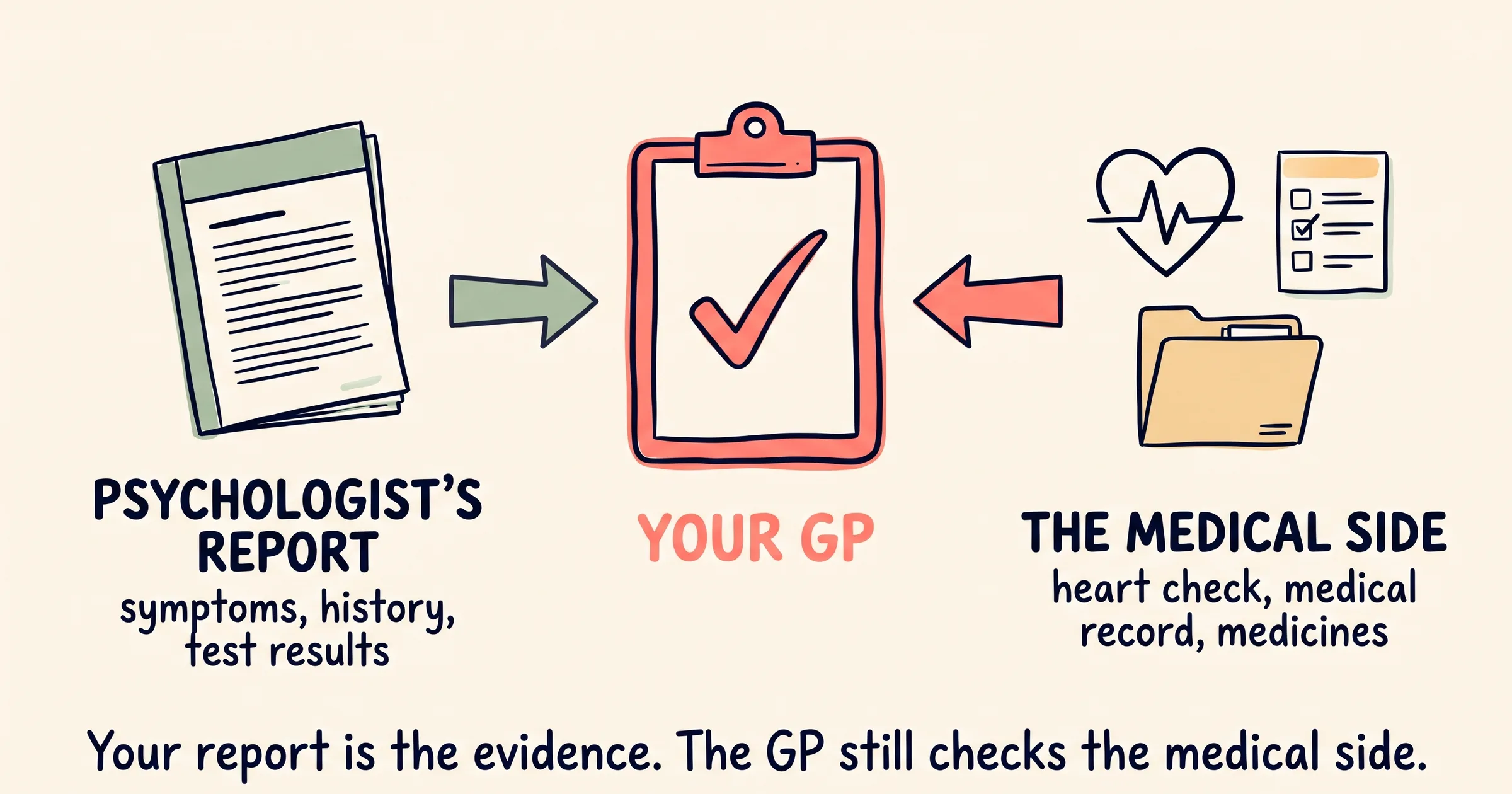
If you already have an ADHD diagnosis, from a psychologist, a psychiatrist, a paediatrician, another GP or any other practitioner, and you now want a GP to prescribe ADHD medication, you still need to book a first appointment with that GP. It is charged at the GP’s normal initial fee, because the GP who prescribes has to complete their own assessment before starting a Schedule 8 medicine. Your earlier diagnosis and report still matter: a clear, thorough one can mean a shorter or skipped second appointment. This guide explains who can diagnose and who can prescribe, what the GP does that a report cannot, what you pay, what changes if you already take medication, and how Medicare applies to telehealth.
In this article
- The short answer
- Does it matter who gave you the diagnosis?
- Why the GP cannot simply accept an earlier diagnosis
- What the GP checks that a report does not cover
- If you already take ADHD medication
- Why the GP reads your whole report, and why we still ask for our intake
- Do you pay the full price?
- How many appointments to plan for
- If your report also mentions autism traits or anxiety
- Medicare and telehealth
- How to get the most from your existing diagnosis
- Frequently asked questions
The short answer
- Yes, you still book a first appointment, whoever gave you the diagnosis. The GP who prescribes is responsible for their own assessment. The Medical Board of Australia does not support prescribing for a patient without a real-time consultation [1].
- It is charged at the GP’s initial appointment fee. The first appointment is a full clinical consultation, not a quick sign-off. Each GP sets their own fees, shown on their profile.
- Your earlier report can reduce the total. If it is clear and thorough and your history is straightforward, the GP may tell you a shorter second appointment, or no second appointment, is needed [5]. The GP decides this after seeing you.
- The GP reads your whole report themselves. Reports vary a lot and are often long, and privacy guidance means a doctor should not paste your report into a public AI tool to summarise it. Our standardised intake gives the GP the same core information, in the same format, for every patient [7][8].
- Only some practitioners can prescribe ADHD medication. Psychiatrists are medical doctors and can prescribe; psychologists are not and cannot [9]. Under the PBS, a nurse practitioner can prescribe ADHD stimulant medicines as a PBS benefit only when continuing treatment that a medical practitioner started [12]. Which doctors can start ADHD medication depends on your state. In Queensland, for example, specialist GPs, psychiatrists and, for younger patients, paediatricians can [2].
- If you already take ADHD medication, a GP may be able to continue it. That depends on your state and the GP’s authority, and the GP still sees you first [1][13].
- Telehealth Medicare rebates are limited for new patients. A first video appointment with a practice you have never visited in person usually does not meet Medicare’s telehealth rule [4].
Does it matter who gave you the diagnosis?
A diagnosis from a trained practitioner counts as evidence, whoever made it. Apart from prescribing, which is restricted to medical practitioners and, in some circumstances, nurse practitioners, the Australian ADHD guideline does not say which professionals can diagnose ADHD, as long as they are appropriately trained and credentialed and work within their expertise [3]. What changes is what the GP who prescribes can do next.
| Who diagnosed you | What it means for the GP appointment |
|---|---|
| A psychologist | Your report is strong evidence, but psychologists cannot prescribe [9]. The GP does their own assessment before starting medication [3]. |
| A psychiatrist | Psychiatrists are medical doctors and can prescribe [9]. If a psychiatrist started your medicine and you are stable on it, some states, such as New South Wales, let a GP with the right authority continue it [13]. The GP still sees you first [1]. |
| A paediatrician, when you were a child | Your childhood diagnosis and records are useful evidence. The guideline describes ADHD as a lifelong condition [3], and the GP still confirms for themselves that the diagnostic criteria are met [3]. |
| Another GP, a nurse practitioner or an online ADHD service | The same rule applies: the GP who prescribes assesses you and confirms the diagnosis for themselves [3]. Under the PBS, a nurse practitioner can prescribe ADHD stimulant medicines as a PBS benefit only when continuing treatment that a medical practitioner started [12]. |
In Queensland, Queensland Health’s advice for someone who was prescribed psychostimulants as a child and has turned 18 is that, if they were not diagnosed by a paediatrician or psychiatrist as a child, they should be referred to a psychiatrist to review the diagnosis and ongoing treatment before turning 25. Alternatively, a specialist GP may continue treatment where appropriate [2].
Whoever made your diagnosis, bring the report or letter, and anything that shows who made it and when.
Why the GP cannot simply accept an earlier diagnosis
A diagnosis from a psychologist, psychiatrist or another trained practitioner is a real diagnosis. The Australian ADHD guideline describes ADHD diagnosis as the province of psychiatrists, paediatricians and psychologists, with GPs increasingly trained to do it too [3]. The question is not whether your diagnosis counts. It is who takes responsibility for the medicine.
ADHD stimulant medicines are Schedule 8 controlled medicines. The doctor who prescribes them does so under their own registration and their own authority. Two rules shape what that doctor must do:
- They must see you. The Medical Board of Australia’s telehealth guidance says: “Prescribing or providing healthcare for a patient without a real-time direct consultation, whether in-person, via video or telephone, is not good practice and is not supported by the Board.” [1]
- They must assess you before starting medication. The Australian ADHD guideline recommends that, before medication starts, a full assessment includes confirmation that the ADHD diagnostic criteria are met, along with a physical health assessment [3].
So the GP reads your earlier diagnosis and report as evidence, then confirms the diagnosis for themselves.
What the GP can do next depends on where you live, because each state and territory sets its own rules for ADHD medication. In Queensland, for example, specialist GPs can diagnose ADHD in adults and start, change and continue ADHD medication without a psychiatrist referral, within set maximum doses [2][6]. In other states the rules differ: in Victoria, for example, most doctors need a permit before prescribing ADHD stimulants [10], and in New South Wales GPs need an authority from NSW Health, with some limited to continuing treatment [11]. Check the current rules for your state: Queensland, New South Wales, Victoria, South Australia, Western Australia, Tasmania, ACT and Northern Territory. For an overview, read can a GP prescribe ADHD medication in Australia?
What the GP checks that a report does not cover
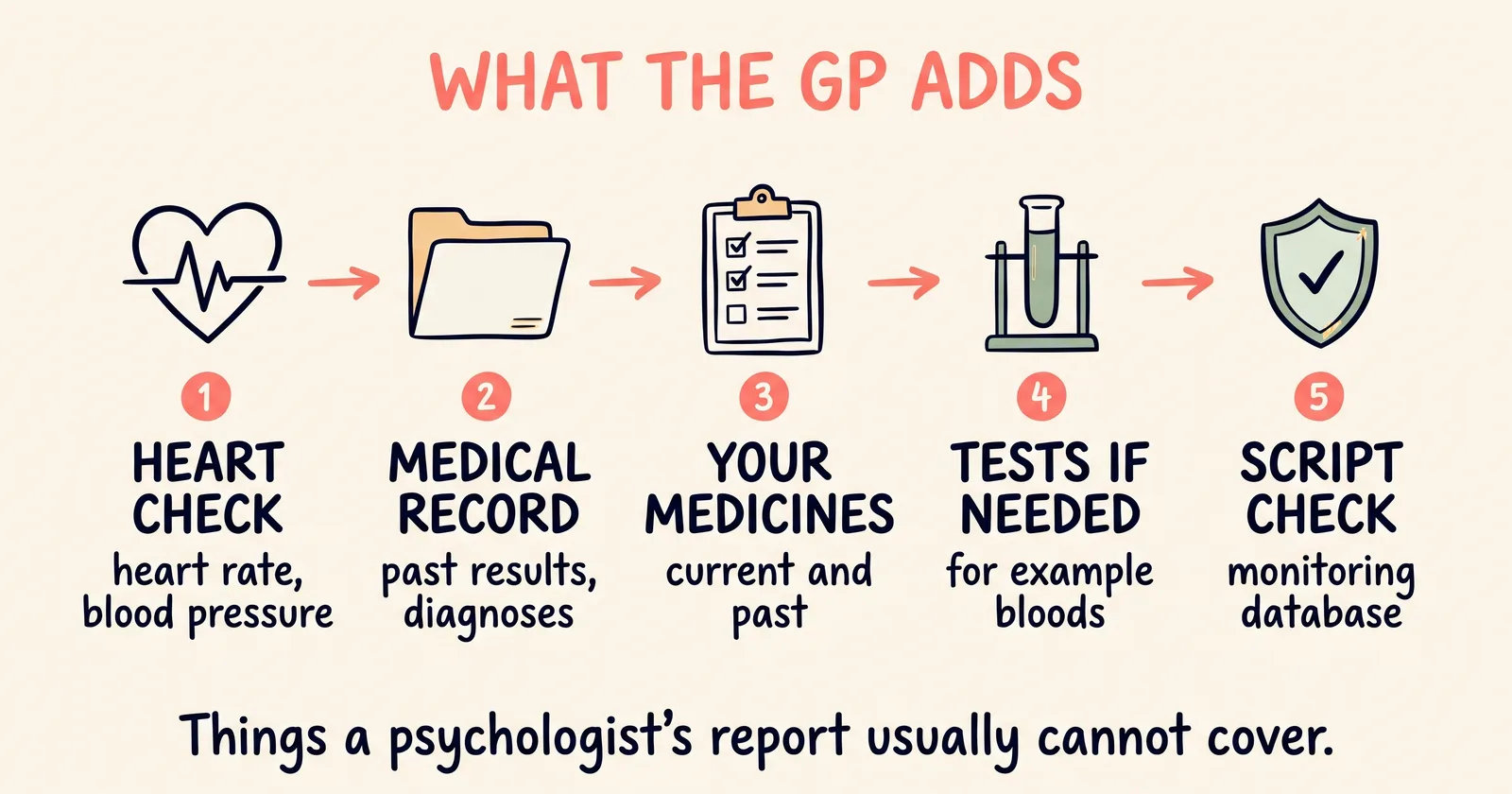
A diagnostic report usually covers your symptoms, history and test results in depth. A GP’s assessment before medication covers the medical side. The Australian ADHD guideline lists what should be assessed before starting ADHD medication [3]:
- confirmation that the ADHD diagnostic criteria are met
- your current work or study situation
- risk of substance misuse and of medicine being diverted to someone else
- your medical history, including conditions that may rule out particular medicines
- your current medicines
- height and weight
- a heart check, including baseline heart rate and blood pressure.
The GP also brings the wider medical context a diagnostic report usually does not have:
- Your medical record. The GP checks your health records, including My Health Record where available, for past diagnoses, results and medicines.
- Other causes. The guideline asks clinicians to look for things that can look like ADHD or make it worse, such as hearing or vision problems, thyroid disease and anaemia, and for medicines that affect concentration or restlessness [3].
- Tests, if needed. The GP may request blood tests or other investigations. The guideline says these should be done when clinically indicated, not routinely [3]. A psychologist cannot order them. Read more in do you need an ECG or blood tests before ADHD medication?
- Prescription monitoring. The GP checks your record of controlled medicines in the state’s prescription monitoring system. In Queensland, for example, the GP must check QScript before prescribing [2].
The GPs listed on MySpecialistGP review your clinical history, psychologist assessments, My Health Record and prescription history, and look at co-existing mental health conditions, physical health and developmental history, before confirming a diagnosis and deciding whether medication is suitable [5]. A diagnosis does not always lead to medication. As Queensland Government advice puts it, not everyone with ADHD will need medication [6].
If you already take ADHD medication
Some people have a diagnosis and already take ADHD medication that a psychiatrist, paediatrician or another doctor started. Whether a GP can take over the prescribing depends on your state and on that GP’s authority.
- New South Wales. A GP with a continuation authority can prescribe psychostimulant medicines for patients aged 6 and over who have already been diagnosed with ADHD and are already stable on psychostimulants. Diagnosing, stabilising and starting these medicines is generally limited to paediatricians, psychiatrists, neurologists and other NSW authorised prescribers [13].
- Queensland. Specialist GPs can start, change and continue ADHD medication for adults, within set maximum doses [2][6].
Other states have their own rules: read can a GP prescribe ADHD medication in Australia? or the page for your state. Even when a GP can continue your medicine, the Medical Board of Australia does not support prescribing without a real-time consultation [1]. The GP will see you, check your prescription history and confirm the medicine is still right and stable for you [5].
Bring a record from your prescriber if you can: the medicine, the dose and the date of your last review. For what happens after the first appointment, see ADHD ongoing care.
Why the GP reads your whole report, and why we still ask for our intake
Every report is different. Psychologists, psychiatrists and other practitioners use different questionnaires, structure their reports differently and write at different lengths. Some reports are a few pages. Others are very long. There is no standard format the GP can skim.
So the GP reads the report in full, themselves. They cannot hand it to a public AI chatbot to summarise. Your report contains sensitive health information, and the privacy rules are clear:
- The Office of the Australian Information Commissioner (OAIC) recommends that organisations “do not enter personal information, and particularly sensitive information, into publicly available generative AI tools, due to the significant and complex privacy risks involved.” [7]
- Ahpra and the National Boards remind practitioners that their codes of conduct require them to protect patient confidentiality and privacy when using AI, to involve patients in decisions to use AI tools that need their personal data, and to obtain informed consent [8].
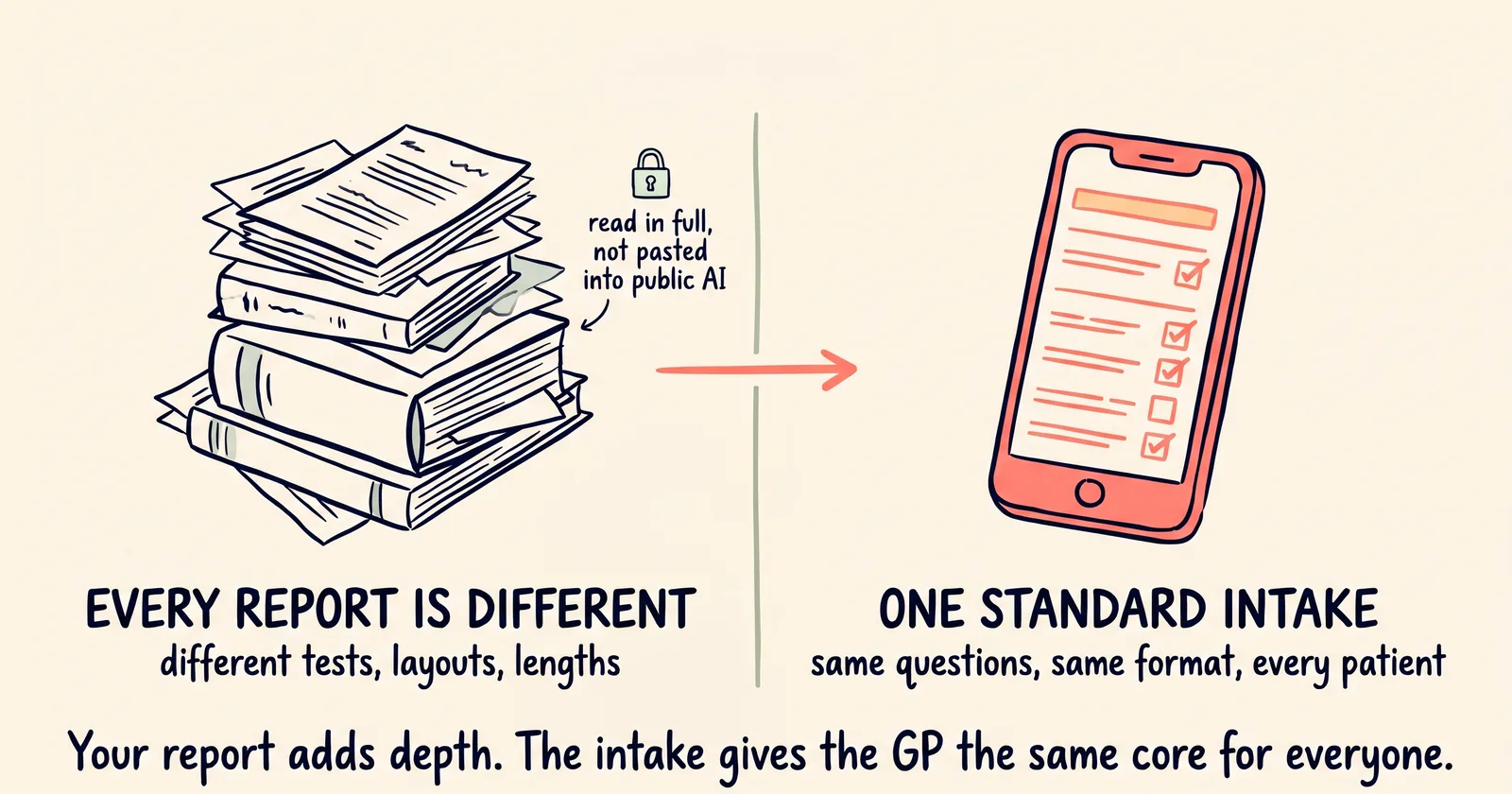
Reading a long, unstandardised report carefully takes clinical time, and that time is part of the appointment.
This is why we ask you to complete our intake as well, even if you already have a diagnosis and a report. The intake collects the same questionnaires, observer reports and history for every patient, one question at a time, in the same format [5]. That gives the GP:
- a consistent starting point they know how to read, whoever assessed you before
- answers to the questions they need for their own assessment, which an earlier report may not cover, such as your medicines and physical health
- a way to check that your current answers line up with what the report found.
Your earlier report adds depth and history. The intake gives the GP the consistent core. Upload the report inside the intake so both arrive together.
Do you pay the full price?
For the first appointment, yes. It is charged at the GP’s normal initial appointment fee, because the clinical work is the same: the GP is meeting you for the first time and has to satisfy themselves of your diagnosis and your health before prescribing.
What you can save on is the number of appointments. A new patient generally needs two longer appointments. If your report is high quality and your situation is straightforward, the GP may shorten or skip the second one and move you straight to review appointments [5].
A few things worth knowing:
- Each GP sets their own fees. Check the GP’s profile or the ADHD assessment pricing page. The fee shown is for that appointment, not the whole pathway.
- A long report is not always a shortcut. Some reports are very long. The GP still has to read and weigh every page, so a longer report does not automatically mean a shorter appointment.
- Review appointments come after. If you start treatment, shorter review appointments follow. See ADHD ongoing care.
For a worked estimate of the whole pathway, read how much a full adult ADHD assessment costs.
How many appointments to plan for
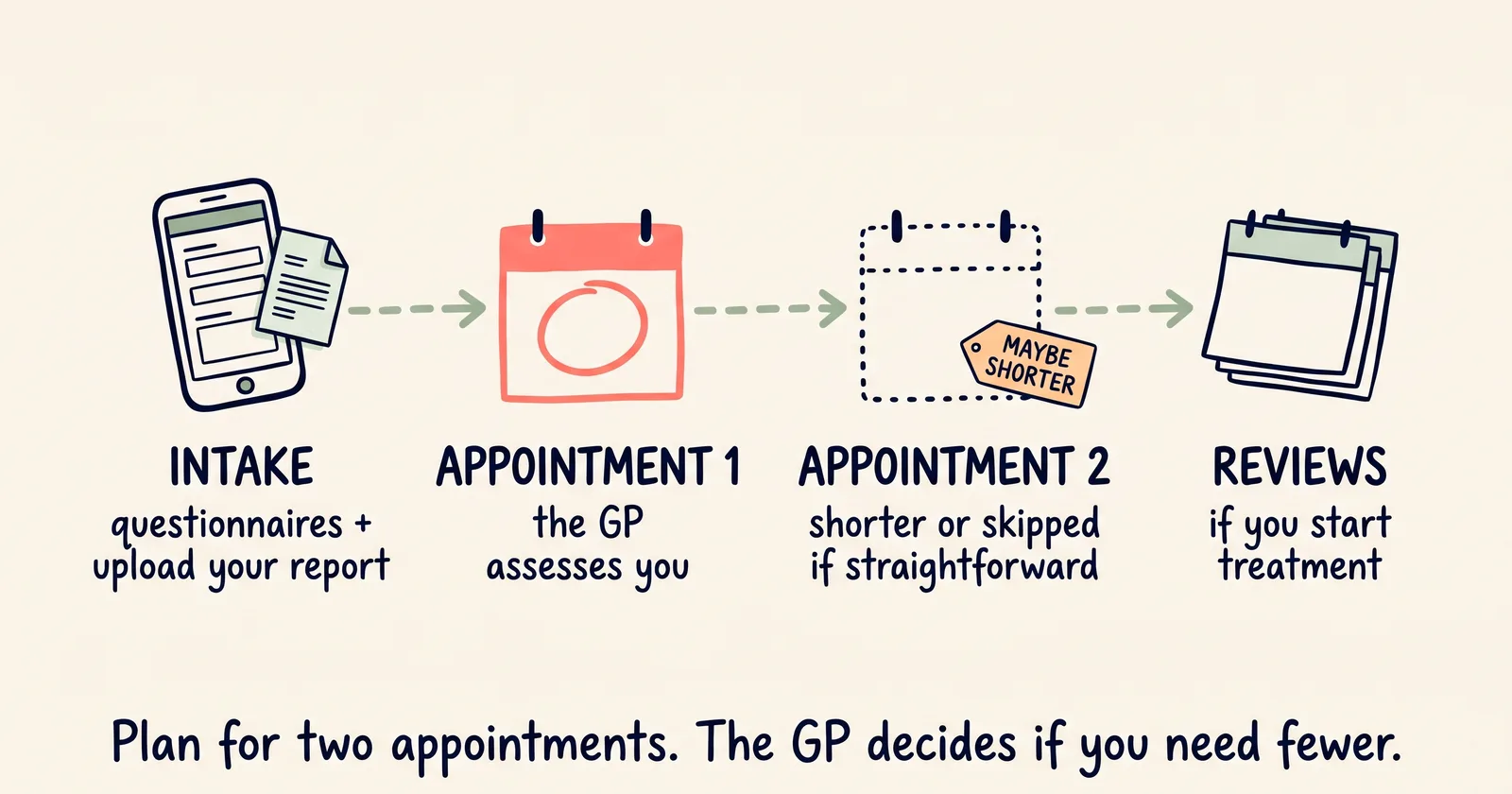
| Appointment | What happens | With a thorough earlier report |
|---|---|---|
| First appointment | The GP reviews your report, history and health, and assesses you | Still needed |
| Second appointment | The GP confirms the picture and, if appropriate, discusses treatment | May be shorter, or not needed. The GP decides |
| Further appointment | Sometimes needed when the history is more involved | Less likely, but possible |
| Reviews | Shorter appointments to monitor treatment | Same as anyone else |
Plan for two. The GP will tell you after the first appointment whether the second can be shorter or skipped [5]. No GP can promise a diagnosis or a prescription before seeing you, and you should be wary of anyone who does.
If your report also mentions autism traits or anxiety
Many diagnostic reports note more than ADHD. That is common, and it does not rule out a GP. The Australian ADHD guideline states that ADHD can be diagnosed in the presence of other conditions, and reports that up to 80% of adults with ADHD have at least one additional mental health condition [3]. Anxiety disorders are among the most common in adults [3].
Whether a GP can take you on, or needs a psychiatrist involved, is a clinical judgement made after the first appointment, not by email before you book. Queensland Government advice, for example, is direct about this: “Your specialist GP may still need to refer you to a psychiatrist for assessment, diagnosis or management of ADHD, particularly if you have other medical conditions.” [6]
If the GP cannot make a diagnosis or take on your ongoing management, the GPs listed on MySpecialistGP offer a referral to a psychiatrist you choose, and can write to your regular GP [5].
An ADHD assessment is not an autism assessment. If you want a formal autism diagnosis, ask the GP whether they provide it. For more on how anxiety and ADHD overlap, read ADHD and anxiety: why they look alike and how GPs tell them apart.
Medicare and telehealth
For a GP video appointment to attract a Medicare benefit, the MBS rules require one of the following [4]:
- you are registered with MyMedicare at that practice and the appointment is with that practice
- the GP, or the GP’s practice, has given you a face-to-face service in the last 12 months
- a specific exemption applies.
A previous video or phone appointment does not count as face-to-face [4]. So if you have never been seen in person at the GP’s practice, a first telehealth appointment usually does not attract a Medicare benefit. Some GPs bill items that attract a rebate and some do not, so check the GP’s profile or ask the practice. Medicare arrangements with whoever diagnosed you do not carry over to the GP.
Full rules and current amounts: Medicare rebates for ADHD appointments: telehealth and in person.
How to get the most from your existing diagnosis
| What to do | Why it helps |
|---|---|
| Upload the full report, not only the scores or a summary letter | The GP needs the instruments used, the findings and the reasoning behind the diagnosis |
| Make sure it names the practitioner who assessed you, their qualifications and the date | The GP needs to know who assessed you and when |
| Include anything about your childhood: school reports, or a parent’s or sibling’s account | ADHD typically begins before age 12 [3] |
| Complete the intake questionnaires as well, and upload the report inside it | The intake gives the GP the same standardised core for every patient; the report adds depth |
| If you take ADHD medication, bring a record from your prescriber: the medicine, the dose and when you were last reviewed | The GP reviews prescription history before deciding on treatment, and whether they can continue it |
| List your current medicines and check your My Health Record | The GP reviews prescription history before deciding on treatment |
| Mention every other diagnosis or past treatment, even if it seems unrelated | This is how the GP decides whether specialist input is needed |
The AADPA guideline says rating scales are “valuable adjuncts to the assessment process”, but that a diagnosis “should not be made solely based on rating scales or observational data” [3]. A report that explains how the diagnosis was reached is far more useful to the GP than a page of scores.
Our guide on how to prepare for your first ADHD assessment with a GP covers the rest.
MySpecialistGP is not a medical practice. We help you prepare for an ADHD assessment and connect you with independent GPs who practise under their own registration. The assessment, any diagnosis and any treatment decision belong to the GP. To see the GPs currently listed, visit Find a GP or the page for your state.
This article is general information, not personal medical advice. For advice about your own situation, speak with your GP or another qualified health professional. Last reviewed: 9 November 2026.
Frequently asked questions
I already have an ADHD diagnosis. Do I still need to book a full appointment?
Yes, you still need a full first appointment. Whoever made your diagnosis, the GP who prescribes is responsible for their own assessment and must see you in a real-time consultation. They read your earlier report as evidence, confirm the diagnosis and check your physical health before deciding on medication.
Does it matter who gave me my diagnosis?
A diagnosis from a trained practitioner counts as evidence, whoever made it. Apart from prescribing, which is restricted to medical practitioners and, in some circumstances, nurse practitioners, the Australian ADHD guideline does not limit which professionals can diagnose ADHD. The GP who prescribes still assesses you and confirms the diagnosis for themselves.
Do I have to pay the full price if I already have a diagnosis?
The first appointment is charged at the GP’s normal initial fee, because the clinical work is the same. Where you may save is the second appointment: if your report is thorough and your situation straightforward, the GP may shorten or skip it. Each GP sets their own fees, shown on their profile.
Why do I have to fill in your questionnaires if I already have a diagnosis and report?
Reports vary in format and length, and the GP has to read yours in full themselves. Privacy guidance means they should not paste it into a public AI tool to summarise it. The intake gives the GP the same standardised questionnaires and history for every patient, and covers things an earlier report may not, such as your medicines and physical health. Upload your report inside the intake so the GP has both.
Can I skip straight to a prescription?
No, you cannot skip the assessment. ADHD stimulant medicines are Schedule 8 controlled medicines, and the prescribing doctor must be satisfied that the medicine is appropriate and safe for you. That requires an assessment, including a heart rate and blood pressure check, your medical record and current medicines, and sometimes blood tests.
Why can’t my psychologist prescribe?
Psychologists are not medical doctors and cannot prescribe medication. ADHD medication is prescribed by doctors, and which doctors can start it depends on your state. In Queensland, for example, specialist GPs and psychiatrists can prescribe for adults, and paediatricians for young adults up to 24. Check the page for your state.
Will the GP accept my diagnosis?
The GP will review it carefully and use it as evidence. They still have to confirm for themselves that the diagnostic criteria are met. A clear, thorough report usually makes that easier.
I already take ADHD medication. Can a GP continue it?
Sometimes. It depends on your state and the GP’s authority. In New South Wales, for example, a GP with a continuation authority can prescribe psychostimulant medicines for patients who have already been diagnosed and are stable on them. The GP still has to see you first, check your prescription history and confirm the medicine is right for you now.
I was diagnosed as a child. Do I need to be assessed again?
The GP will use your childhood diagnosis and records as evidence, but they still confirm for themselves that the diagnostic criteria are met now. The Australian ADHD guideline describes ADHD as a lifelong condition, and symptoms typically begin before age 12. Bring any records you have, such as paediatrician letters or school reports. The GP decides what else they need.
My report says I also have autism traits or anxiety. Is that too complex for a GP?
Not automatically. ADHD can be diagnosed alongside other conditions. The GP decides after the first appointment whether they can take you on or whether a psychiatrist should be involved. Nobody can decide that by email before you book.
Can I claim a Medicare rebate for a telehealth appointment with a GP I have not seen before?
Usually not. For a GP video appointment to attract a Medicare benefit, you generally need MyMedicare registration with that practice, a face-to-face service from the GP or practice in the last 12 months, or an exemption. Ask the practice what applies before you book.
What should I send the GP before my first appointment?
Your full diagnostic report, any childhood evidence such as school reports, a record from your prescriber if you already take ADHD medication, a list of your current medicines, and the GP’s own intake questionnaires. Mention every other diagnosis or past treatment.
Sources
- Medical Board of Australia. Guidelines: Telehealth consultations with patients. Checked 27 October 2026. https://www.medicalboard.gov.au/codes-guidelines-policies/telehealth-consultations-with-patients.aspx
- Queensland Health. Prescribing psychostimulants: Medicines and Poisons Act 2019 (fact sheet), December 2025. Checked 27 October 2026. https://www.health.qld.gov.au/__data/assets/pdf_file/0021/1160391/fs-prescribing-psychostimulants.pdf
- Australasian ADHD Professionals Association. Australian Evidence-Based Clinical Practice Guideline for Attention Deficit Hyperactivity Disorder, updated January 2026. Recommendations 2.1.2, 2.1.4, 2.2.1 and 5.1.2, the section on training of health professionals, and the narrative review on co-occurring conditions. https://aadpa.com.au/wp-content/uploads/2026/01/Australian-Clinical-Practice-Guideline-For-ADHD-Updated-January-2026.pdf
- Australian Government Department of Health and Aged Care. MBS Note AN.1.1: Eligibility criteria for MBS telehealth (video and phone). MBS Online. Checked 27 October 2026. https://www9.health.gov.au/mbs/fullDisplay.cfm?type=note&q=AN.1.1&qt=noteID
- MySpecialistGP. Frequently asked questions, and the assessment process published by the listed GP. https://myspecialistgp.com.au/faq/
- Queensland Government. Attention deficit hyperactivity disorder (ADHD) management. Last updated 23 December 2025. Checked 27 October 2026. https://www.qld.gov.au/health/conditions/all/adhd
- Office of the Australian Information Commissioner. Guidance on privacy and the use of commercially available AI products. Published 21 October 2024. Checked 27 October 2026. https://www.oaic.gov.au/privacy/privacy-guidance-for-organisations-and-government-agencies/guidance-on-privacy-and-the-use-of-commercially-available-ai-products
- Ahpra and National Boards. Meeting your professional obligations when using Artificial Intelligence in healthcare. Checked 27 October 2026. https://www.ahpra.gov.au/Resources/Artificial-Intelligence-in-healthcare.aspx
- Royal Australian and New Zealand College of Psychiatrists. Psychiatrists and psychologists: what’s the difference? Your Health in Mind. Checked 27 October 2026. https://www.yourhealthinmind.org/psychiatry-explained/psychiatrists-and-psychologists
- Victorian Department of Health. Stimulants for ADHD or narcolepsy: permit requirements. Page updated 7 September 2026. https://www.health.vic.gov.au/drugs-and-poisons/stimulants-for-adhd-or-narcolepsy-permit-requirements
- NSW Health. Expanding access to ADHD management: information for continuation prescribers. Checked 9 November 2026. https://www.health.nsw.gov.au/pharmaceutical/prescribers/Pages/adhd-management-prescribes.aspx
- Pharmaceutical Benefits Scheme. PBS listings for ADHD stimulant medicines: authority restriction, treatment criteria. Checked 9 November 2026. https://www.pbs.gov.au/medicine/item/3440c
- NSW Health. Criteria for the management of medicines for ADHD by continuation prescribers. Updated 10 February 2026. Checked 9 November 2026. https://www.health.nsw.gov.au/pharmaceutical/Documents/criteria-adhd-management-prescribes.pdf
General health information
This article is general health information only. It is not a substitute for professional medical advice, diagnosis, or treatment. Always speak with a qualified health professional before making any changes to your medication or treatment plan.
MySpecialistGP is a health information and GP directory service operated by Webbed Feet Pty Ltd. Read our Medical Disclaimer.
