
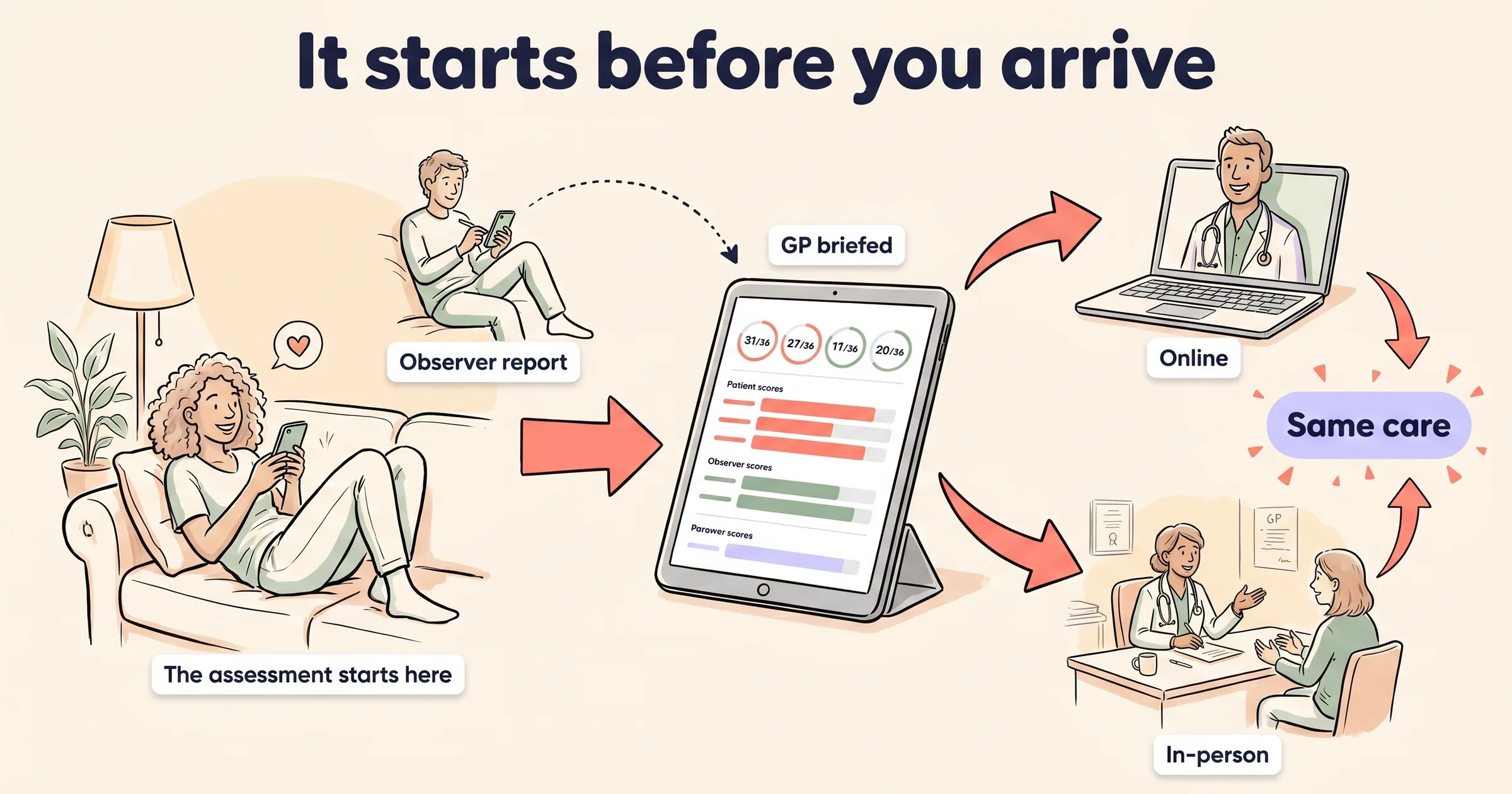
Online and in-person ADHD assessment appointments each have a place. The right format depends on what your clinician needs to assess, whether a physical examination is required, your privacy and technology setup, and your own circumstances. A video appointment is not automatically better or worse than an in-person visit. Your clinician should decide whether it is safe and suitable for you.
In this article
- What is the real difference between online and in-person assessment?
- What each format may add
- When an in-person appointment may suit
- When an online appointment may suit
- How to prepare for either format
- What a thorough ADHD assessment needs
- Telehealth, Medicare and State rules
- Frequently asked questions
ABOUT MY SPECIALIST GP
Your GP can now assess ADHD. We made the getting-there part easier.
We explain how ADHD assessment works in Australia, and connect you with independent GPs who assess and treat it.
- Find and book a GP. Browse independent GPs who assess ADHD, by state, and book on the GP’s own profile page.
- Get the GP-Ready ADHD Dossier. Questionnaires, an observer report, your history and your documents, organised into one file for your GP.
TWO WAYS TO START
Start wherever you are.
Book with a listed GP, or prepare your file first and take it to any GP you choose.
My Specialist GP is an education and connection platform. We are not a clinic and we do not diagnose or prescribe; the independent GPs listed here do.
What is the real difference between online and in-person assessment?
The appointment format is one part of an ADHD assessment. A thorough assessment considers symptoms, their impact on daily life, information from more than one setting, relevant history and possible co-occurring or alternative conditions.
It is not based on a video image, a waiting-room impression or a questionnaire alone.
The Australian ADHD Clinical Practice Guideline describes interviews, rating scales and information from more than one person as key parts of the assessment process.
Your clinician decides what information is needed and whether it can be gathered safely by video, in person, or across more than one appointment.
What each format may add
Both formats can suit different circumstances. The choice should fit the clinical work required and your practical circumstances.
What an in-person appointment may add
- An in-person appointment may allow a physical examination where the clinician considers one necessary.
- It may suit a person who does not have a private or reliable video setup.
- The gap between how someone presents and how they feel, sometimes visible before a word is spoken
An in-person appointment may suit you when a clinician needs to perform a physical examination, when video is not private or reliable enough, or when you would feel more comfortable meeting face to face.
What a video appointment needs
- Video works best with a private, quiet space and reliable connection.
- The clinician decides whether video is safe and suitable for the appointment.
An online appointment may suit you when the clinician considers video safe and clinically appropriate and you have a private room, reliable internet and a suitable device.
Preparation before the appointment
- A clinician may ask for information from parents, carers, teachers or other people who know the child.
- The clinician decides whether in-person care is needed for any part of the assessment.
A structured history, questionnaires, observer information and relevant documents can help a clinician understand your circumstances before the consultation. They support, rather than replace, the clinician’s assessment.
When an in-person appointment may suit
An in-person appointment may be the right choice when the clinician needs information that is easier to gather in the room or needs to perform a physical examination.
You can still prepare before an in-person appointment. Write down current difficulties, collect relevant documents, and ask whether someone who knows you well can provide information if the clinician requests it.
Choose the format that gives the clinician the information they need and gives you a workable way to attend.
When an online appointment may suit
An online appointment may suit you when video is clinically appropriate and practical for your circumstances.
- Questionnaires or rating scales where relevant
- Personal and medical history
- Observer information where requested
- Relevant documents, such as school reports, where available
Before booking, ask the clinician or practice whether the appointment can be provided by video and whether any steps need to happen in person.
If a GP offers structured pre-appointment preparation, it may include questionnaires, observer information and relevant documents. Check the individual GP profile for the process they offer.
How to prepare for either format
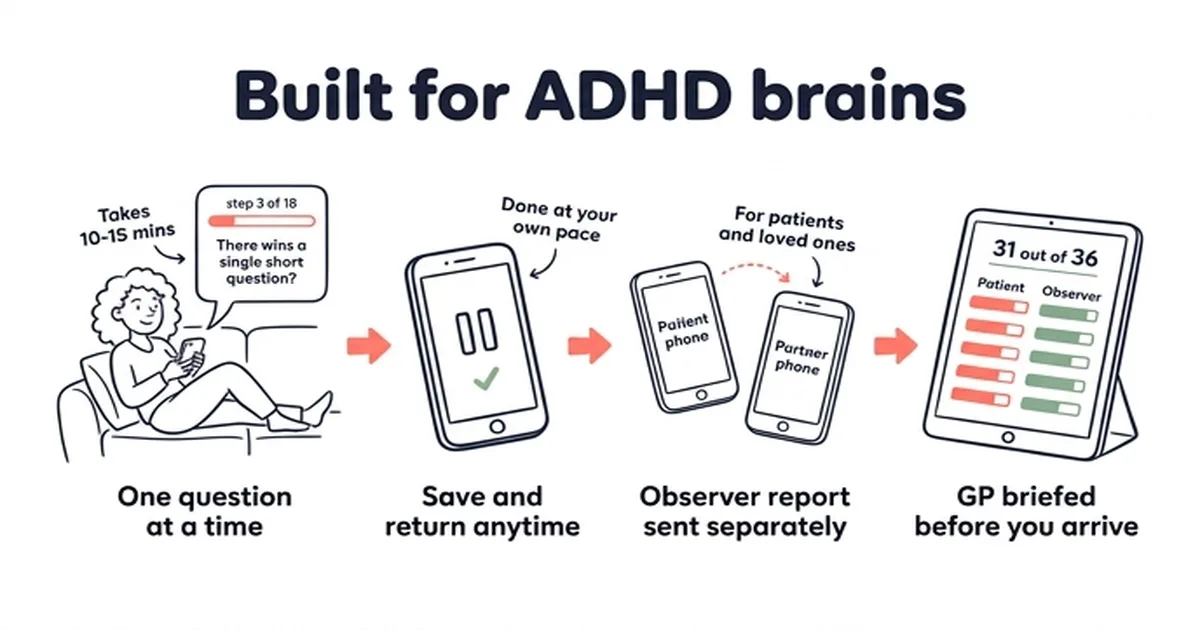
Preparing information before either format can make it easier to explain what has been difficult in daily life.
Use the format that helps you give the clinician a clear account of your history and current circumstances.
If a GP uses a structured intake, complete it at a pace that lets you give accurate information. Ask the practice what information is useful before the appointment.
An observer report, where requested, gives the clinician another source of information about daily functioning.
Relevant documents, such as school reports, can be helpful where they are available. Do not delay asking about an appointment solely because you cannot find every old document.
Read how to prepare for your first ADHD assessment with a GP for practical preparation guidance.
Preparation supports the appointment. The treating clinician reviews the information, asks follow-up questions and makes every clinical decision.
What a thorough ADHD assessment needs
ADHD may be under-recognised in girls and women. A clinician should consider the person’s history, functional impact and information from relevant settings, rather than relying on one moment in a consultation.
Women with ADHD often present as calm, articulate, and composed in professional and clinical settings while managing significant difficulties in every other area of their life.
People can present differently in a clinical setting from how they manage at home, work, study or school.
Preparation gives you time to record examples from daily life before the appointment. It does not determine the clinical outcome.
Read how a telehealth ADHD appointment works for information about the consultation process.
Telehealth, Medicare and State rules
Telehealth eligibility for Medicare benefits is separate from whether a clinician considers video suitable for your appointment.
- Current symptoms and functional impact
- Relevant personal and medical history
- Information from relevant settings or observers where requested
- Childhood information where available
For many general practice video services, Medicare eligibility depends on receiving care through your MyMedicare-registered practice, having an eligible telehealth practitioner, or meeting an exemption. A previous video appointment does not count as the face-to-face service needed for ongoing eligibility.
Ask about the practice fee and any out-of-pocket cost before booking. Read the current Medicare rules for telehealth and in-person ADHD appointments for the current explanation and official MBS links.
Frequently asked questions
Can an ADHD assessment happen by video?
Some ADHD assessment appointments can be provided by video when the clinician considers telehealth safe and suitable. The clinician decides whether an in-person appointment, examination or follow-up is needed. A video format does not remove the need for a full clinical assessment.
Is an online ADHD assessment the same as an in-person assessment?
The assessment standard is not reduced because a consultation happens by video. The Australian ADHD guideline says services may be delivered in different formats, but some services need in-person care, including physical examinations. The clinician should choose the format that fits the clinical work required.
Do I need to meet the GP in person before a telehealth appointment?
The clinical answer depends on the appointment and clinician. For Medicare benefits on many GP telehealth services, you must meet the current eligibility pathway, such as an established clinical relationship, MyMedicare registration with the practice, or an exemption. Confirm this with the practice before booking.
Do I need childhood school reports for an ADHD assessment?
School reports and other childhood information can be useful where available. The clinician reviews the full information available and decides what else is needed. Do not delay asking about an appointment solely because you cannot find every old document.
Is a questionnaire enough to diagnose ADHD?
No. Rating scales and questionnaires are one source of information. A clinician also considers your history, functional impact, information from relevant settings and other conditions that may need to be considered.
What should I do if I am unsure which format to book?
Ask the clinician or practice which format they offer for a first ADHD appointment and whether any part needs to happen in person. Tell them about travel, privacy, internet access, caring responsibilities and whether a parent or support person needs to attend.
General health information
This article is general health information only. It is not a substitute for professional medical advice, diagnosis, or treatment. Always speak with a qualified health professional before making any changes to your medication or treatment plan.
MySpecialistGP is a health information and GP directory service operated by Webbed Feet Pty Ltd. Read our Medical Disclaimer.
