

A telehealth ADHD assessment with a trained GP follows a structured process. Most of the work happens before your appointment, from your phone, at your own pace. Here is exactly what happens at each step, what you need to prepare, and how long it takes.
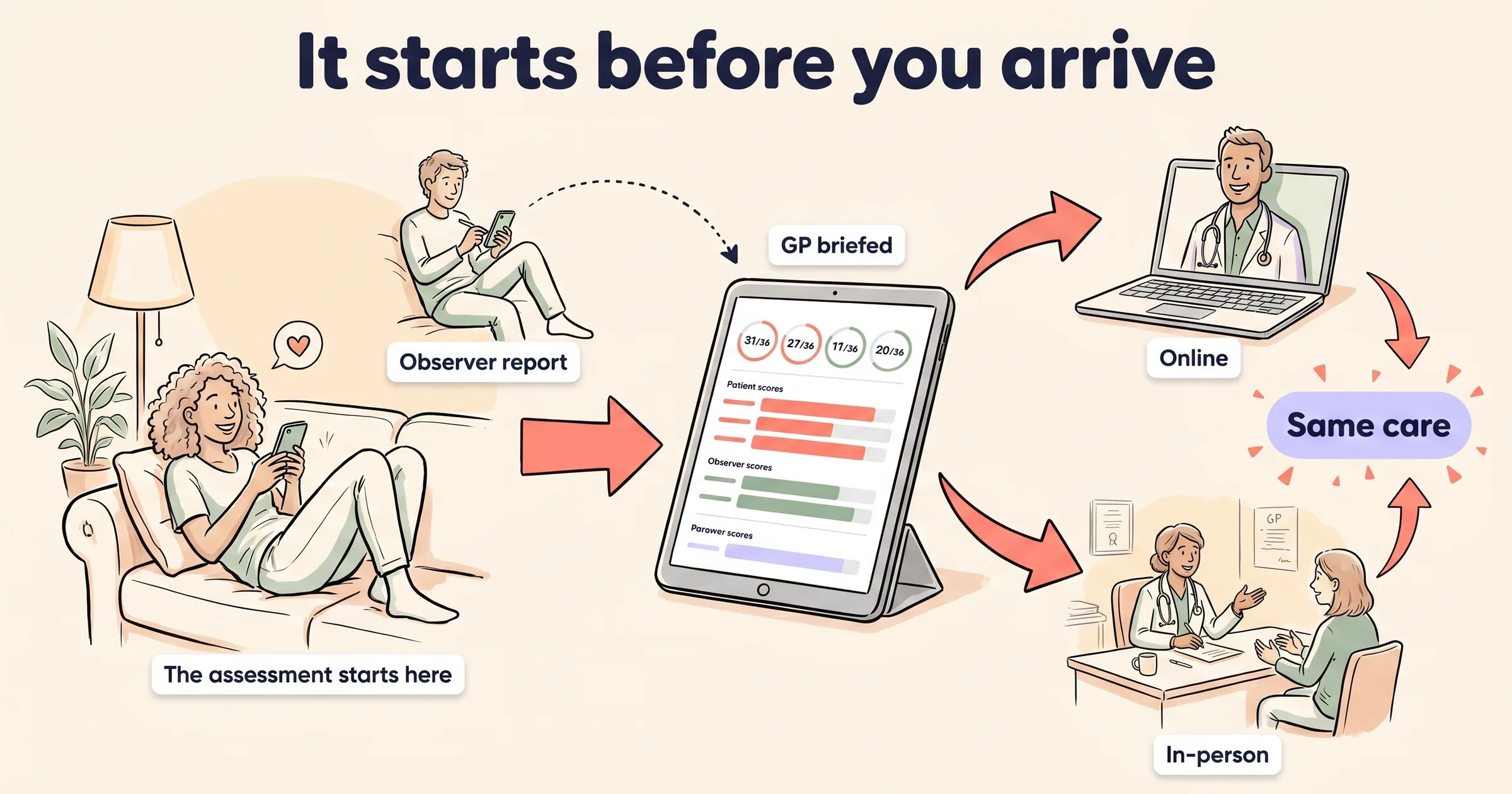
Why we built an app for this.
Standard telehealth means answering questions live under pressure. We moved that out of the appointment. You go at your own pace from your phone, and the GP gets a structured summary before you join the call.
The app is called Velluto. Italian for velvet. Genuine care, engineered into every step from the moment you book.
Every GP in our practice uses it. That means a more thorough assessment, a shorter consultation, and one less appointment to pay for.
Read: Online or in-person ADHD assessment: what is genuinely different, and what our intake does about it
In this article
- Step 1: Book your appointment online
- Step 2: Complete your intake
- Step 3: Nominate an observer
- Step 4: Provide childhood evidence
- Step 5: GP reviews your structured summary
- Step 6: First telehealth appointment
- Step 7: Follow-up and diagnosis
Step 1: Book your appointment online
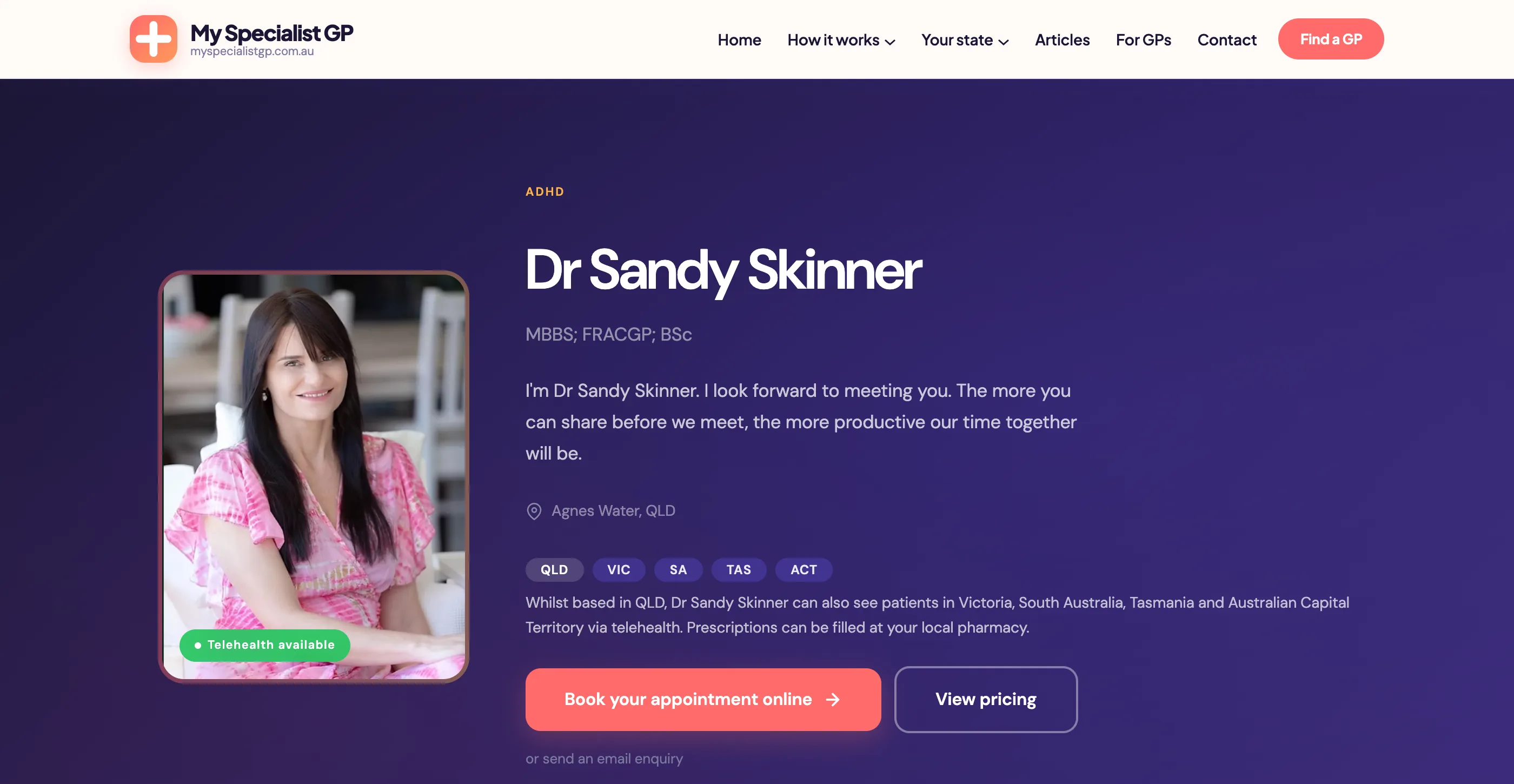
Find an ADHD telehealth GP by clicking Find a GP. You will see the GPs and their profile page, with a link to their available appointment slots. Choose a time that works for you and book.
You will then receive an email instantly with a payment link to to secure your booking. You receive instant confirmation by email. No phone calls, no waiting for a callback. You pick the time, pay, and you are booked.
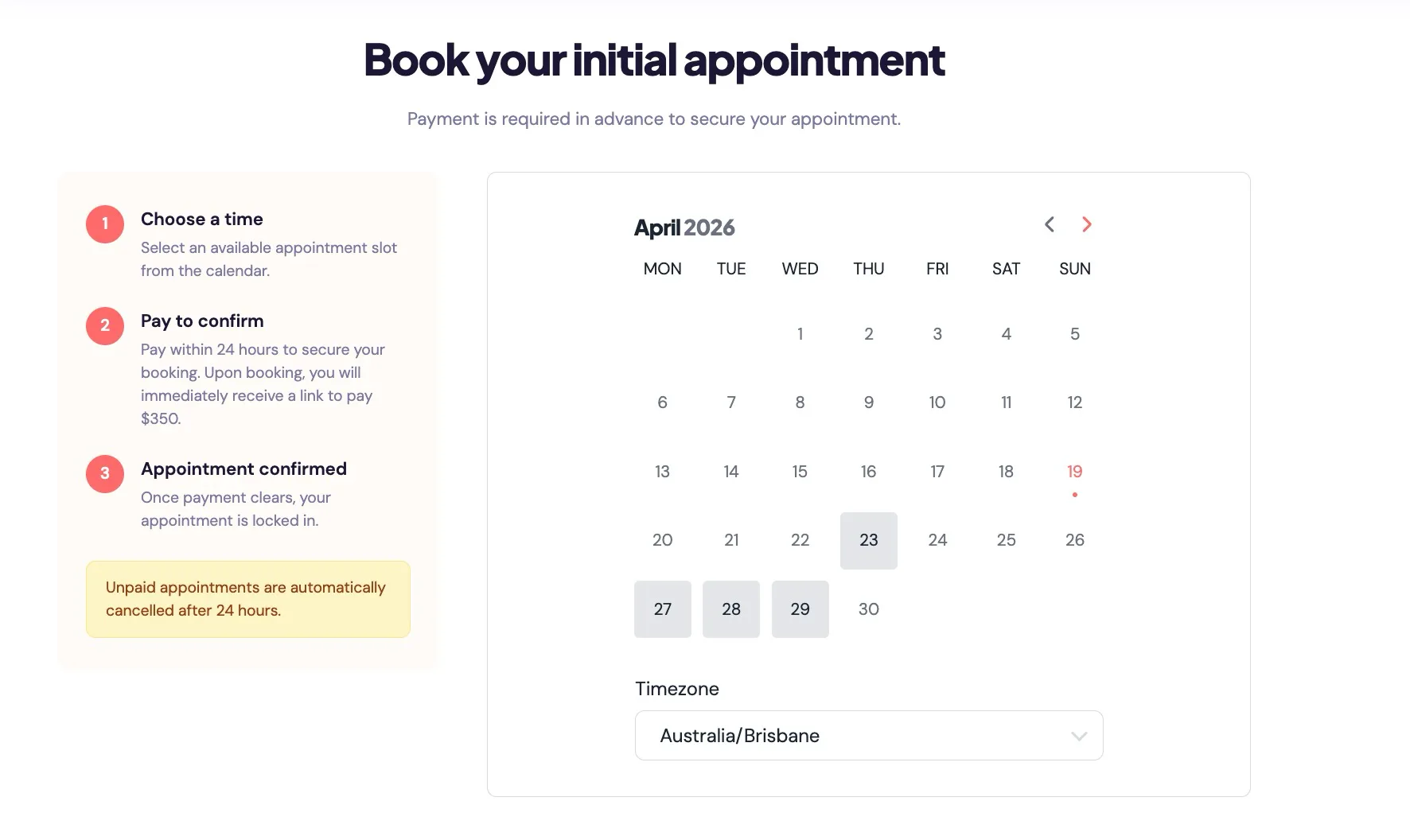
Once your appointment is confirmed, you receive a secure link to start your pre-consultation intake via Velluto.
Step 2: Complete your intake
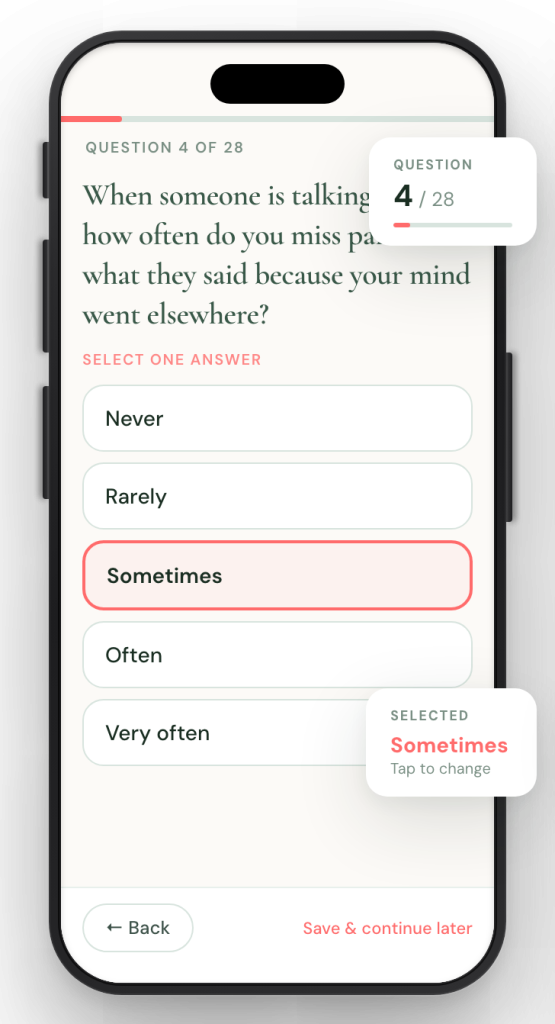
You receive a secure intake link by email after booking. Open it on your phone or computer. The intake is designed to be completed in short sections, one at a time. You do not need to finish it in one sitting.
The intake covers seven sections:
- Consent: privacy and data handling
- About you: basic details and why you are seeking assessment
- ASRS v1.1: the Adult ADHD Self-Report Scale, a standardised screening questionnaire used in clinical guidelines worldwide
- Medical history: current medications, past diagnoses, mental health history
- Childhood: your recollection of symptoms before age 12 (more on this in Step 4)
- Daily impact: how symptoms affect your work, relationships, and daily life right now
- Thinking style: patterns of attention, organisation, and emotional regulation
Each section takes roughly 3 to 5 minutes. Total intake time is typically 20 to 30 minutes, but you can save your progress and come back whenever you are ready.
Step 3: Nominate an observer
You nominate someone who knows you well in your current daily life. This person receives their own independent questionnaire about your behaviour. They complete it separately from you.
Who counts as an observer:
- Partner or spouse
- Parent
- Sibling
- Close friend
- Housemate
- Colleague who works closely with you
The observer does not need to be a family member. They need to be someone who sees you regularly enough to comment on things like organisation, attention, impulsivity, and time management.
What the observer fills in:
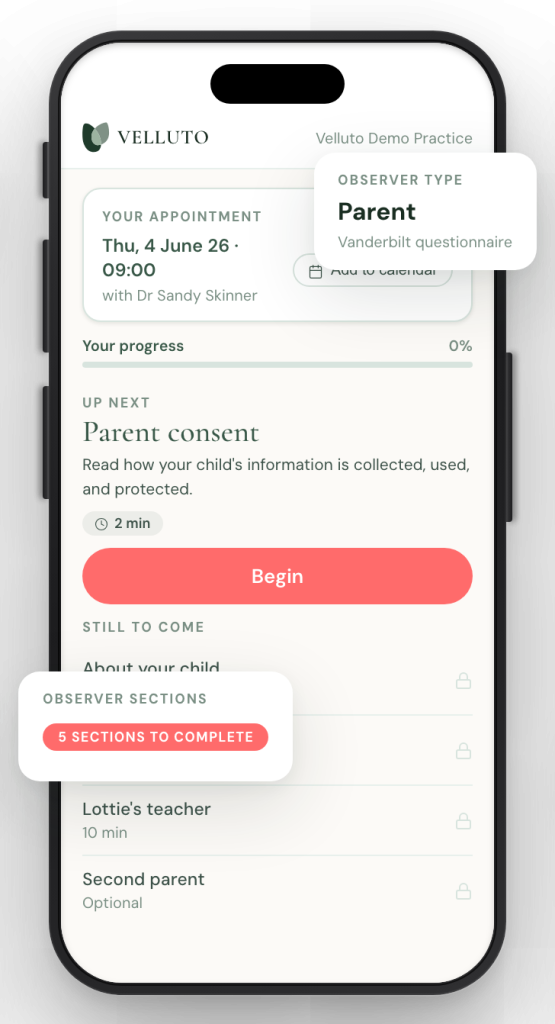
The observer receives their own secure link by email. They answer a quick structured questionnaire about your behaviour, independently. Their responses are compared with yours as part of the clinical picture. This is not a pass/fail. Discrepancies between self-report and observer report are themselves clinically useful.
What if you genuinely have nobody?
If you do not have anyone who can complete an observer report, tell the practice. Your GP can still proceed with the assessment. Observer data strengthens the clinical picture but is not an absolute requirement for diagnosis.
Step 4: Provide childhood evidence
This is the step that causes the most confusion. Here is what it actually means and what your options are.
Why childhood evidence matters:
ADHD is a neurodevelopmental condition. The diagnostic criteria require that symptoms were present before age 12. Your GP needs some form of evidence that your symptoms are not new. This does not mean you needed a diagnosis as a child. It means something needs to indicate that the pattern existed early.
What counts as childhood evidence:
- School reports from primary school (ages 5 to 12). Teacher comments like “easily distracted”, “does not complete work”, “talks too much”, “bright but not reaching potential” are exactly what your GP is looking for.
- A letter from a parent, sibling, or someone who knew you as a child. This is a simple written account describing your behaviour, attention, and functioning before age 12.
- A family member completing a structured questionnaire about your childhood behaviour. Your GP’s practice provides this.
- Historical records such as paediatrician reports, educational psychologist assessments, or early intervention records.
What if you do not have school reports?
Most people over 40 do not have their primary school reports. That is normal. You have options:
- Contact your state or territory Department of Education. In most states, you can request historical school records by filling in a direct release form. This takes a few weeks but is typically available online. Search for “historical school records” on your state education department website.
- Ask a parent or sibling to write a letter or complete a questionnaire about what you were like as a child. Even brief recollections are useful.
- Provide whatever you do have. One report card with a relevant comment is more useful than none. High school reports can supplement primary school evidence.
What if you have no family or childhood contacts at all?
If your family situation means nobody from your childhood can provide information, and no school records exist, your GP can still assess you. You will be asked to describe your own childhood experiences in detail during the intake and during the consultation. A chaotic or disrupted childhood does not disqualify you from assessment. Your GP will work with whatever evidence is available.
Childhood evidence is uploaded directly through Velluto. You photograph school reports, letters, or documents from your phone and upload them in the intake.
Step 5: GP reviews your structured summary
Before your appointment, your GP receives a structured clinical summary through Velluto. This is not a stack of raw questionnaires. It is an organised report that includes:
- Scored ASRS results with flagged items
- Observer report results, compared side by side with your self-report
- Medical and mental health history
- Childhood evidence summary
- Functional impact assessment
- Consistency analysis across all data points
This means your GP walks into the appointment already understanding your clinical picture. The consultation time is spent on clinical assessment, not on collecting information you have already provided.
Step 6: First telehealth appointment
Your first appointment is 45 minutes by video call. Your GP has already reviewed your full intake summary, so the conversation starts at what matters.
During the appointment, your GP will:
- Discuss your symptoms and how they affect your daily life
- Ask targeted follow-up questions based on your intake responses
- Explore whether other conditions might explain your symptoms (anxiety, depression, sleep disorders, and ADHD frequently overlap)
- Review your childhood history and any evidence provided
- Explain what happens next
Your GP is not re-asking the same questions you already answered in the intake. The pre-consultation work means the appointment is a clinical conversation, not a form-filling exercise.
Step 7: Follow-up and diagnosis
A follow-up appointment is booked 1 to 2 weeks after your first consultation. At this appointment:
- Your GP confirms or discusses the diagnosis
- A treatment plan is discussed, including medication options if appropriate
- In Queensland, your GP can prescribe stimulant medication directly. No psychiatrist referral is required for initial prescribing.
- Ongoing care is planned, including follow-up appointments for medication monitoring
Total time from booking to diagnosis: typically 2 to 4 weeks, depending on how quickly you complete the intake and how soon appointment slots are available.
Ready to get started? Find a GP and book your assessment online.
General health information
This article is general health information only. It is not a substitute for professional medical advice, diagnosis, or treatment. Always speak with a qualified health professional before making any changes to your medication or treatment plan.
MySpecialistGP is a health information and GP directory service operated by Webbed Feet Pty Ltd. Read our Medical Disclaimer.
