
The GP-ready ADHD pre-assessment
Walk into your GP appointment with the hard part already done.
Your GP can now assess ADHD. We built a way to get there that doesn’t fight your brain: questionnaires, an observer report, your history and your documents, completed from your couch, one question at a time, then organised into a file your GP can actually work from. Take it to any GP you choose.
Founding price ($77 from launch), GST included. Full refund if it doesn’t work for you.
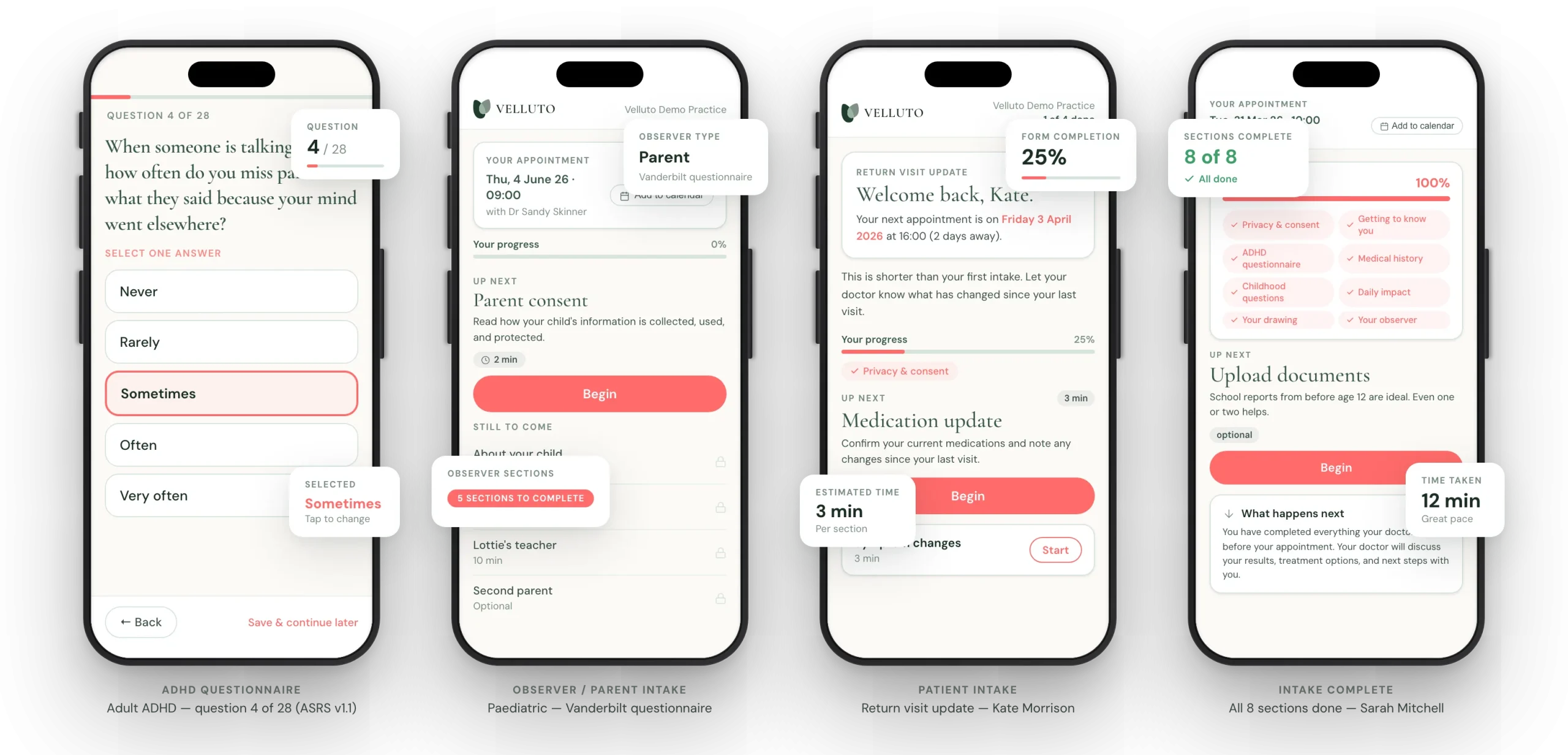
Your GP-ready file
Prepared for your doctor
Complete
ASRS ADHD assessment
Complete
Observer report
Complete
Childhood evidence
Complete
Your story, in your words
3 attached
Your documents and reports
Includes a cover page for your GP explaining what this file is, what it isn’t, and how it was gathered.
Why this exists
A standard appointment is fifteen minutes. Your history is twenty years long.
Most people walk in and try to reconstruct a lifetime from memory, on the spot, with the clock running. What you were like at school. Whether it shows up at work and at home. What someone close to you has actually noticed. That is a lot to produce under pressure, and it is exactly the kind of task an ADHD brain finds hardest.
So the appointment goes one of two ways. Either your doctor spends most of it gathering background instead of assessing you, or you book another one to finish the job. Either way you have paid for the visit and you are not much further along.
That is the part we could fix. Not the assessment, that stays your doctor’s. The preparation.
This is what the Velluto method feels like
Real words from the people who went through it. No forms. No friction.
It’s really straightforward. It walks you through one question at a time, and being able to answer by voice was genuinely helpful.
L
Lisa
Did the Velluto Method
You managed to gamify the intake process so well that it made me want to complete all the steps! Best of all, I didn’t have to keep repeating myself.
A
Anonymous
Did the Velluto Method
I really liked the step-by-step flow. You can see how many steps there are and your progress. No frustrating moments, no errors.
G
Greg
Did the Velluto Method
Where it came from
These are the documents we already use. People asked if they could have them.
The dossier was not built to sell. It was built with Dr Sandy Skinner, who has run more than 100 adult ADHD assessments this way, so the background is gathered before an appointment instead of during one. Everyone who books a GP through this site already completes it.
Then people who weren’t booking through us started asking the obvious question: could they have the same thing, to take to their own doctor? There was no good reason to say no. So we are trialling it, twenty at a time, at close to what it costs us to run.
How it works
Done from your couch. One question at a time.
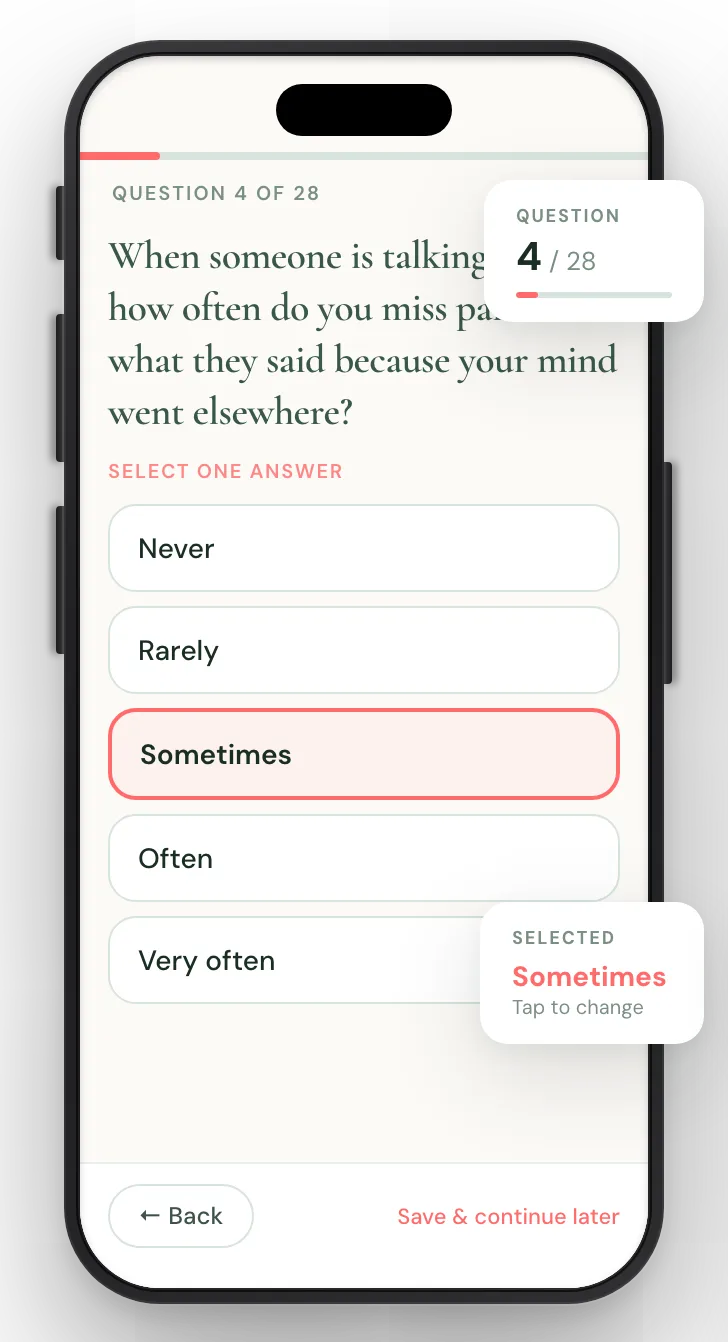
Tell your story once.Tell your story once.
Work through the ASRS v1.1, the childhood questionnaire and your history on your phone, at your own pace. Stop and come back whenever you need. No forms in waiting rooms, no remembering everything on the spot.
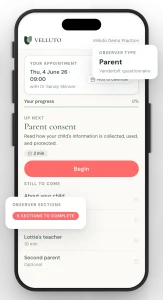
We gather the rest
We invite someone who knows you to complete an observer report, ask someone who knew you as a child about back then, and collect your documents, like school reports or past letters. You just forward a link.
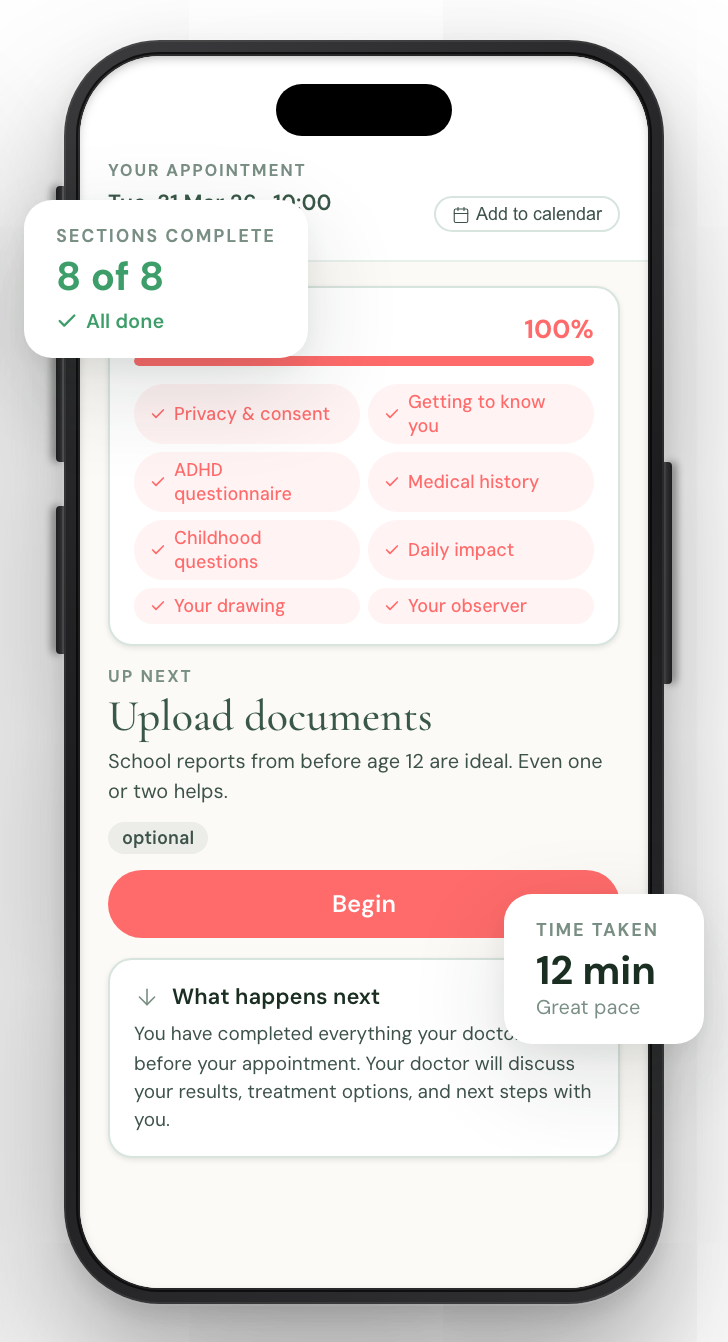
It arrives before you do.
Everything is organised into one clinician-ready file with a cover page for your doctor. Take it to your own GP and it reaches them ahead of the appointment so the time can go on the assessment rather than the paperwork.
What’s in the file
Built on the clinical instruments doctors already use.
Instruments (the clinical word for standardised, validated questionnaires) are what doctors work from, not quizzes. Nothing in your file is invented by us: it’s built on named instruments, plus your own words and your own records, structured the way a doctor needs them.
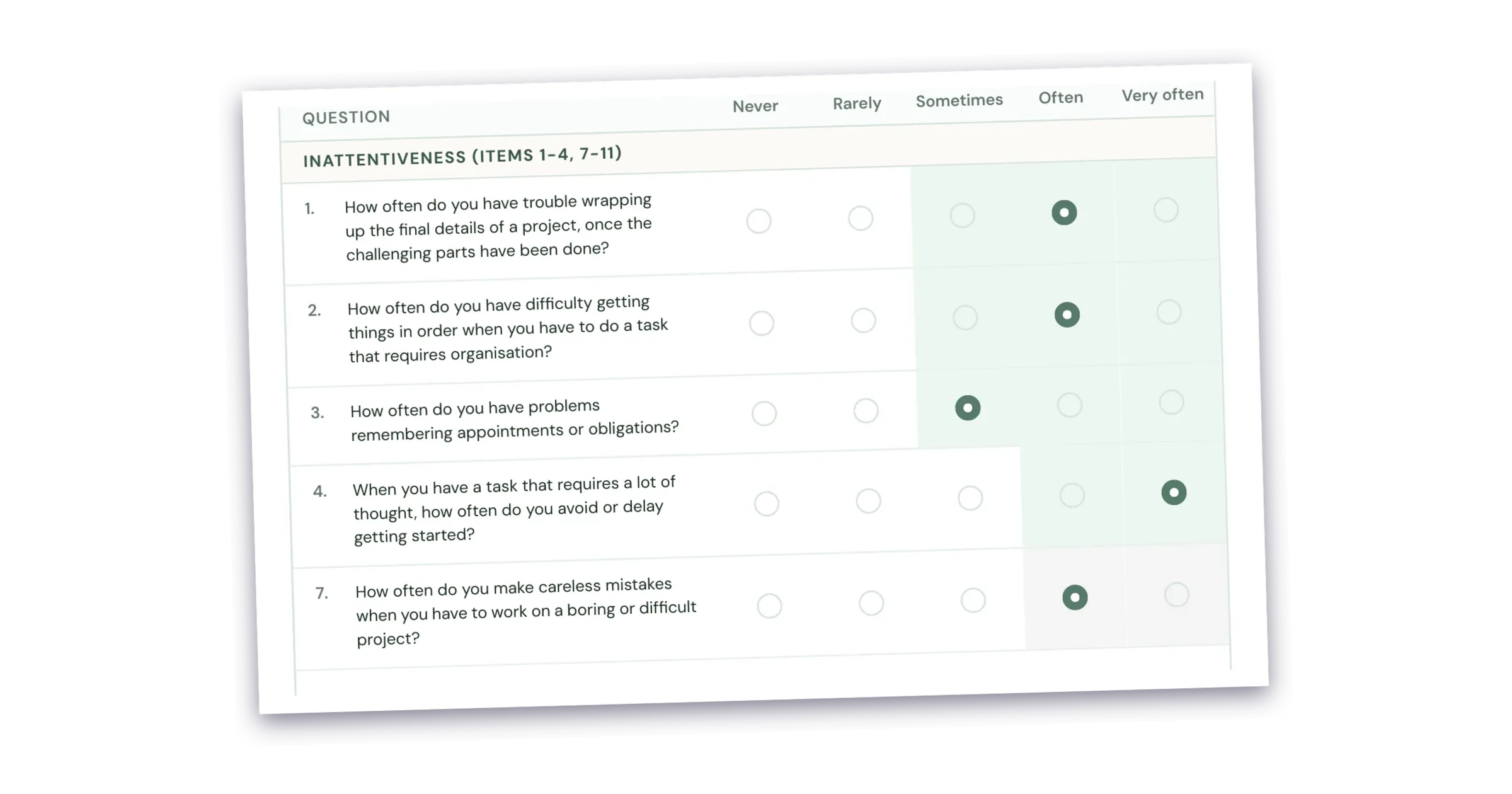
Your side
ASRS
The World Health Organization’s adult ADHD self-report instrument. Eighteen questions about how things are for you now. It’s the starting point most Australian GPs expect to see.
A second perspective
Observer report
A partner, parent or close friend answers the same eighteen questions about you, so your GP sees your experience and an outside view side by side, like for like.
Back then
Childhood evidence
ADHD starts in childhood, so doctors need to know what you were like as a kid. Someone who knew you before age 12 answers a structured questionnaire about back then, and your old school reports slot in alongside.
Your words
How it affects your life
Open questions about work or study, relationships and daily tasks, answered in your own words. This is the context that numbers alone can’t carry.
The fuller picture
Related check-ins
Where it will help your GP, your file can include recognised instruments for things that often travel with ADHD, like the K10, PHQ-9 and GAD-7 that Australian GPs use every day for stress, mood and anxiety. Again: no scores shown to you, no conclusions drawn.
Why GPs can rely on it
Care in the gathering
Your file notes how it was collected: unhurried, in your own time, with your observer answering independently. Simple consistency notes help your GP rely on what they’re reading.
The rules
What your doctor has to establish.
ADHD isn’t diagnosed on a feeling. Doctors work to published diagnostic criteria, and the rules are public. We can’t apply them to you, only your doctor can do that. But we can show you what they are, because they’re the reason your file contains what it contains.
Enough symptoms, for long enough
At least five of the recognised symptoms for adults, present for six months or more.
In your file: ASRS v1.1 + observer report
It started in childhood
Several symptoms were already there before age 12, even if nobody named them at the time.
In your file: childhood evidence + school reports
It shows up in more than one setting
Home, work, study, relationships. Not just one corner of life.
In your file: your story + an outside view
It genuinely gets in the way
Clear interference with how you function day to day, not just a preference or a quirk.
In your file: how it affects your life, in your words
Nothing else explains it better
Your doctor has to consider whether something else, like anxiety or low mood, fits the picture better.
In your file: related check-ins
Summarised in plain English from the DSM-5 criteria doctors in Australia work to. This is general information so you know what your appointment is for. Whether you meet the criteria is your doctor’s assessment, and your file never claims it for you.
Where it goes
Your file. Your choice of doctor.
Take it to your own GP
If you have a GP you trust, stay with them. We’ll send your finished file to your doctor electronically and securely at no extra cost, or you can download it and hand it over yourself. Either way it arrives with a cover page explaining exactly what it is and how it was gathered. Whether and how they use it is their professional call, which is how it should be.
Booking a GP listed here? Skip the pack.
Every booking made through My Specialist GP already includes this questionnaire. You receive it after you book, and your answers reach the GP before the appointment. You do not need to buy the pack as well.
The file is yours either way, and it isn’t only for GPs. If you’d rather take it to a psychiatrist or a paediatrician, you can.
The price
One flat price to launch the new service.
Founding price · first 20 spots
The Doctor-Ready ADHD Dossier
$44 GST included
The everyday price from launch will be $77. The first 20 founding dossiers are $44, and once they’re gone, they’re gone.
- The full dossier: questionnaires, observer and childhood reports, your story, your documents
- One organised, clinician-ready file with a GP cover page
- Sent electronically and securely to your doctor at no extra cost, or download it yourself
- Yours to take to any GP, or one listed here
- Personal help along the way if you get stuck
- Buy today; we’ll be in touch within one business day to get your dossier under way.
Not right for you? Tell us within 30 days for a full refund, no forms. This sits on top of your Australian Consumer Law rights, which we can’t and don’t limit.
Included free
Sent to your doctor
When your file is ready, we send it electronically and securely to the GP you name, at no extra cost. You can download it too. It’s yours.
Included free
The ask-your-GP script
Not sure how to raise it? A short, copy-and-paste message for asking your GP whether they assess ADHD, so you don’t have to find the words from scratch.
Included free
The whole-path guide
What to expect before, on the day, and after: referrals, what your GP may check, and how reviews and renewals work, in plain English, matched to the rules in your state.
Questions
The things people ask first.
Will this tell me if I have ADHD?
No. It won’t give you a result. The scored questionnaires inside are for your doctor to interpret. Diagnosis is a doctor’s job, and a file that tried to do it for them is exactly the kind of thing doctors ignore. This gets you to your appointment prepared; the assessment happens there.
Will my GP actually use it?
That’s their call, and we respect it. What we can tell you is what’s inside: recognised questionnaires GPs already know, an independent observer report, childhood evidence, and your documents, with a cover page explaining how it was all gathered. It’s your file, so you can take it to any doctor you choose, a GP, a psychiatrist or a paediatrician.
How long does it take?
Most of your part can be done in an evening, but there’s no clock on it. Your observer and childhood reports take as long as your people take, and we nudge them gently so you don’t have to.
What happens to my information?
It’s health information and we treat it that way: stored securely in Australia, used to prepare your file and nothing else, and handled under the Australian Privacy Principles. The file is yours. Full details are in our privacy policy.
Why does it cost $44?
$44 is our founding price, GST included, for the first 20 dossiers while the service is new. It covers what it costs us to run yours properly, with personal help along the way. From launch the everyday price will be $77. We’ll be in touch within one business day to get your dossier under way, and you can buy your spot now.
Do I need this if I am booking a GP through this site?
No. Every booking made here includes the same questionnaire, so buy the pack only if you are taking your file to your own GP or to a doctor who is not listed on this site. Already bought it and then booked a GP here? Contact us and we will attach your completed file to the booking.
Buy your GP-ready pack here
Fill this in and pay the $44. We will be in touch within one business day to get your dossier under way.
You’ve already done the hardest part: deciding to look into it.
The rest shouldn’t fight your brain. Start tonight, from the couch, one question at a time, and walk into your appointment ready.
Need to talk to someone now? If you’re in crisis or thinking about self-harm, call Lifeline on 13 11 14 (24 hours) or 000 in an emergency. This service is not a crisis service.